
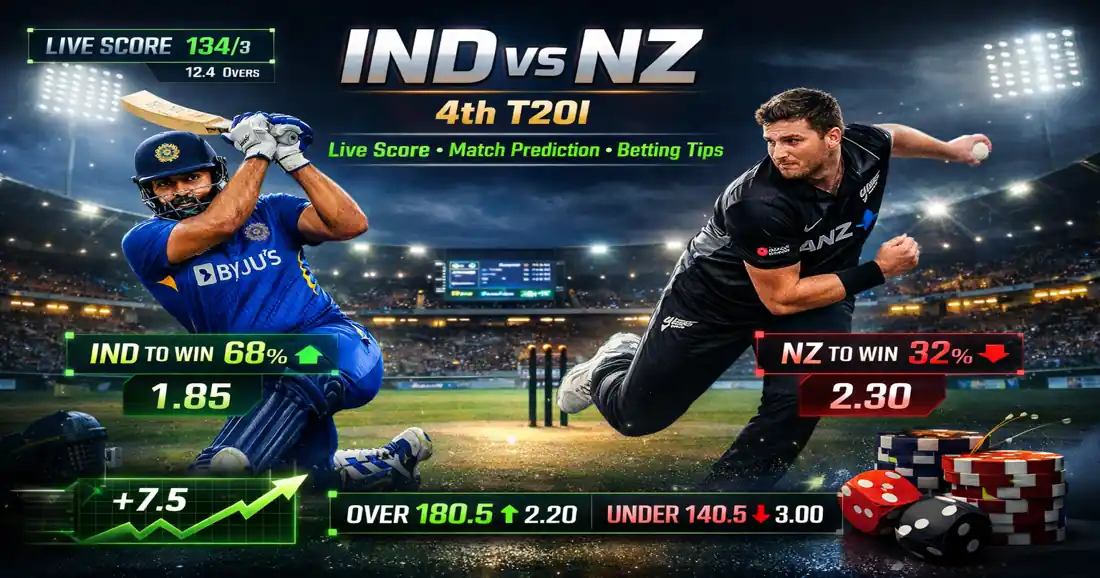
The strategic landscape of international Twenty20 cricket undergoes a significant evaluation as the Indian national team prepares to host New Zealand in the fourth encounter of their five-match series in January 2026. This match, scheduled for January 28 at the Dr. Y.S. Rajasekhara Reddy ACA-VDCA Cricket Stadium in Visakhapatnam, serves as a critical laboratory for both nations as they finalize their tactical frameworks for the ICC Men’s T20 World Cup 2026. For professional analysts, fantasy participants, and users of the Reddy Book Club ecosystem, understanding the deep-seated historical trends, venue-specific data, and squad dynamics is essential for accurate match prediction and strategic engagement. The encounter represents a culmination of years of competitive evolution between two sides that have consistently challenged the boundaries of the shortest format of the game.
Technical and Statistical Foundations of the India-New Zealand T20I Rivalry
The historical parity between India and New Zealand in T20 Internationals reflects a rivalry defined by technical innovation and contrasting sporting philosophies. Across 25 recorded encounters, the statistical distribution of victories suggests a marginal but consistent advantage for the Indian side, which has secured 14 wins against New Zealand’s 10, with a single match resulting in a tie. This competitive balance is particularly noteworthy given the diverse conditions under which these teams have competed, ranging from the high-altitude grounds of New Zealand to the spin-friendly tracks of the Indian subcontinent. The data indicates that India’s success is often predicated on the aggressive output of its top-order batting, while New Zealand’s victories frequently stem from disciplined bowling units and a superior ability to exploit tactical matchups.
Historical Head to Head Record and Performance Disparities
The statistical profile of this rivalry is anchored by individual performances that have set the benchmark for T20 excellence. Rohit Sharma remains the most prolific run-scorer in this head-to-head history, accumulating 511 runs across multiple series, while New Zealand’s Colin Munro has been the primary antagonist for the Indian bowlers, contributing 426 runs with a record of multiple centuries. In the bowling department, the disparity in methodology is evident; Jasprit Bumrah’s 12 wickets highlight the impact of high-pace precision, whereas Ish Sodhi’s 25 wickets underscore the perennial threat posed by leg-spin against Indian middle-order rotations. These benchmarks provide a foundational dataset for those analyzing the “head to head record” for the upcoming 4th T20I.
The following table synthesizes the critical team and individual metrics that define this historical contest :
| Statistical Parameter | India | New Zealand |
| Total T20I Wins | 14 | 10 |
| Highest Team Total | 234/4 | 219/6 |
| Lowest Team Total | 79 | 66 |
| Most Runs Scored | Rohit Sharma (511) | Colin Munro (426) |
| Most Wickets Taken | Jasprit Bumrah (12) | Ish Sodhi (25) |
| Most Individual Fifties | Rohit Sharma (6) | Colin Munro (4) |
| Most Individual Sixes | Rohit Sharma (27) | Colin Munro (24) |
| Highest Individual Score | Shubman Gill (126*) | Colin Munro (109*) |
| Best Bowling Figures | Deepak Hooda (4/10) | Mitchell Santner (4/11) |
The divergence in these figures suggests that while India often controls the “scorecard” through volume and boundaries, New Zealand’s path to victory is more frequently carved through bowling discipline and restricted scoring rates. For users evaluating the “match result” in 2026, the historical dominance of spinners like Ish Sodhi and Mitchell Santner in subcontinental conditions remains a primary variable.
Series Context and World Cup Preparation
The January 2026 series is the final bilateral engagement for both squads before the T20 World Cup begins in February. Under the captaincy of Suryakumar Yadav, the Indian side is undergoing a transition toward a high-risk, high-reward batting model, necessitated by the evolving demands of the global T20 landscape. Conversely, the New Zealand side, led by Mitchell Santner, continues to refine its “utility-first” approach, where multi-skilled players like Rachin Ravindra and Glenn Phillips provide the flexibility required to counter India’s specialist-heavy roster. The 4th T20I in Visakhapatnam is thus positioned as a decisive fixture where both teams will likely test their “probable playing xi” in high-pressure scenarios, simulating World Cup knockout conditions.
This series also follows a historic ODI campaign in which New Zealand achieved its first-ever bilateral series victory on Indian soil. This recent psychological shift cannot be overlooked when formulating a “match prediction” for the T20 matches. The dominance of Daryl Mitchell, who scored 352 runs in that ODI series, establishes him as a critical factor for the T20I “dream11 prediction” and “fantasy tips”. The intersection of recent form and long-term historical data creates a complex environment for “bet online cricket” markets.
Environmental Analysis of the Dr. Y.S. Rajasekhara Reddy ACA-VDCA Stadium
The venue for the 4th T20I, the Dr. Y.S. Rajasekhara Reddy ACA-VDCA Cricket Stadium in Visakhapatnam, is characterized by its balanced nature, often offering a “pitch report” that favors stroke-making while simultaneously assisting spinners as the match progresses. The stadium’s location on the shores of the Bay of Bengal introduces atmospheric variables, most notably the “dew factor,” which plays a disproportionate role in determining the outcome of matches played under lights. Understanding the “pitch morphology” and historical scoring trends at this venue is paramount for accurate “toss prediction” and in-play engagement on the “cricket betting exchange“.
Pitch Morphology and the Evolution of Scoring Trends in Visakhapatnam
The Vizag pitch is traditionally regarded as a batter’s paradise during the early stages, with a consistent bounce that allows for expansive stroke-play. However, data from the IPL 2024 and 2025 seasons show that the surface can support extreme totals, such as Kolkata Knight Riders’ 272/7, as well as low-scoring defensive struggles. In T20 Internationals, the venue has hosted 4 matches, with the team batting second winning 3 of them. This trend highlights the “chasing advantage” that is prevalent in Visakhapatnam, often attributed to the onset of evening dew which makes the ball difficult to grip for spinners and aids the speed of the outfield.
Historical statistics for the venue in the T20 format are detailed below :
| Venue Statistic | T20I Data (Vizag) | IPL Data (Vizag) |
| Total Matches Played | 4 | 17 |
| Won Batting First | 1 | 8 |
| Won Batting Second | 3 | 9 |
| Average 1st Innings Score | 149 | 170 |
| Average 2nd Innings Score | 138 | 165 |
| Highest Total Recorded | 209/8 (India) | 272/7 (KKR) |
| Lowest Total Recorded | 82 (Sri Lanka) | 92 (Mumbai Indians) |
| Highest Individual Score | 110 (Josh Inglis) | 91 (David Warner) |
| Best Bowling Figures | 4/8 (Ravichandran Ashwin) | 6/19 (Adam Zampa) |
The “pitch report” for January 28, 2026, is expected to follow this historical pattern. With an average first-innings score of 149 in T20Is, but a significantly higher average of 170 in domestic T20s, the “match preview” suggests a highly competitive contest where 180+ is a par total. The “who will win today” decision for many analysts will hinge on the “toss prediction,” as the tactical advantage of bowling first is empirically supported by the 75% win rate for chasing teams in T20Is at this ground.
Atmospheric Influence and Meteorological Impact on Match Dynamics
Meteorological data for Visakhapatnam in late January indicates a stable but influential climatic environment. The daytime maximum temperatures are projected to hover around 29°C, falling to a comfortable 18°C to 23°C during the match hours. The primary concern for the “probable playing xi” selection and “betting tips” is the relative humidity, which is expected to range between 45% and 81%. High humidity in a coastal city like Visakhapatnam almost guarantees the presence of dew during the second innings of a night match.
The implications of these weather patterns are twofold. First, the cool sea breeze may assist new-ball bowlers like Arshdeep Singh and Matt Henry in extracting early swing, making the “powerplay” phase critical for both sides. Second, the “live score today” is likely to accelerate during the middle and death overs of the second innings, as the “dew factor” reduces the effectiveness of wrist-spinners like Kuldeep Yadav and Ish Sodhi. For “live match updates,” analysts must monitor the “dew point” as it directly correlates with the “win probability” shift during the match.
Strategic Roster Configurations and Performance Projections
The squads for the January 2026 series reflect the “finalization phase” of both teams’ World Cup strategies. India’s roster has been forced into adjustments due to injuries, while New Zealand’s squad emphasizes consistency and familiarity with subcontinental conditions. The “today match” roster for India will be heavily influenced by the return of key players and the need to assess replacements for injured starters.
Indian Squad Restructuring Amidst Injury Complications
Team India, under the leadership of Suryakumar Yadav, has faced significant disruptions due to injuries to Tilak Varma and Washington Sundar. The selection committee recalled Shreyas Iyer for the first three T20Is as a replacement for Varma, who underwent abdominal surgery. Similarly, Ravi Bishnoi was included for the entire series as a replacement for Sundar, who suffered a side strain. By the 4th T20I on January 28, Tilak Varma is expected to be assessed for a potential return, creating a selection dilemma in the “probable playing xi”.
The updated Indian T20I squad for the series is as follows :
- Leadership: Suryakumar Yadav (Captain), Axar Patel (Vice-Captain).
- Batting Core: Abhishek Sharma, Rinku Singh, Shreyas Iyer (first three matches), Tilak Varma (pending fitness).
- Wicketkeepers: Sanju Samson, Ishan Kishan.
- All-rounders: Hardik Pandya, Shivam Dube.
- Spin Department: Kuldeep Yadav, Ravi Bishnoi, Varun Chakaravarthy.
- Pace Battery: Jasprit Bumrah, Arshdeep Singh, Harshit Rana.
The “match preview” highlights that Abhishek Sharma and Sanju Samson are the likely opening pair, especially with Shubman Gill being omitted from the T20 roster during this phase. This shift suggests an intent to maximize Powerplay scoring, a strategy that will be tested against New Zealand’s disciplined new-ball attack.
New Zealand’s Tactical Blueprint for Subcontinental Supremacy
New Zealand’s strategy, led by Mitchell Santner, is built on a foundation of “tactical versatility”. The squad includes a high concentration of all-rounders and spinners who have significant experience in the “ipl betting apps” and international circuits. The presence of Rachin Ravindra and Daryl Mitchell, both of whom have demonstrated exceptional form against Indian bowlers, makes the Black Caps a formidable opponent even in away conditions.
The New Zealand T20I squad includes :
- Captain: Mitchell Santner.
- Top Order: Devon Conway, Tim Robinson, Mark Chapman.
- Middle Order All-rounders: Michael Bracewell, Rachin Ravindra, James Neesham, Daryl Mitchell.
- Power Hitters: Glenn Phillips, Bevon Jacobs.
- Bowling Attack: Matt Henry, Kyle Jamieson, Ish Sodhi, Jacob Duffy, Zak Foulkes.
The “match prediction” for the 4th T20I must account for the height and bounce generated by Kyle Jamieson, which has historically troubled the Indian top order. Furthermore, Ish Sodhi’s record of 25 wickets against India suggests he will be the primary weapon during the middle overs when the Visakhapatnam pitch begins to offer turn.
Probable Playing XI and Tactical Matchups
For the January 28 encounter, the “probable playing xi” for both teams is expected to prioritize balance between aggression and control.
India Predicted 11:
- Abhishek Sharma: Aggressive left-handed opener.
- Sanju Samson (WK): Power hitter in the Powerplay.
- Suryakumar Yadav (C): Technical anchor and innovative stroke-maker.
- Hardik Pandya: Critical fast-bowling all-rounder.
- Tilak Varma / Shivam Dube: Dependent on Varma’s fitness; Dube provides left-handed power against spin.
- Rinku Singh: Specialist finisher.
- Axar Patel (VC): Utility spinner and lower-order batter.
- Kuldeep Yadav: Primary wrist-spin threat.
- Jasprit Bumrah: New-ball and death-over specialist.
- Arshdeep Singh: Left-arm variation and swing.
- Ravi Bishnoi: Attacking leg-spinner.
New Zealand Predicted 11:
- Devon Conway (WK): Consistent run-getter at the top.
- Tim Robinson: Young explosive opening partner.
- Rachin Ravindra: Versatile all-rounder with excellent form.
- Daryl Mitchell: The “backbone” of the middle order.
- Glenn Phillips: High-impact middle-order batter and elite fielder.
- Michael Bracewell: Off-spin option and lower-order hitter.
- Mitchell Santner (C): Leader and primary defensive spinner.
- James Neesham: Veteran finisher.
- Kyle Jamieson: Tall seamer generating difficult bounce.
- Matt Henry / Zak Foulkes: Consistent new-ball threat.
- Ish Sodhi: Attacking leg-spinner with a strong record against India.
The “matchup intelligence” suggests that the battle between Jasprit Bumrah and Devon Conway will define the Powerplay, while the ability of Shivam Dube and Rinku Singh to counter the spin duo of Santner and Sodhi will likely determine the “match result”.
The Sports Betting Ecosystem and the Reddy Book Club Framework
The 2026 India vs New Zealand series is a major event in the “cricket market,” driving significant engagement across “online cricket betting sites” and “betting apps”. Platforms like the “Reddy Book Club” and “Reddy Anna Book” have emerged as central hubs for “live cricket betting,” offering “online cricket IDs” that provide users with access to “live match updates,” “live scores,” and sophisticated “betting tips”. Understanding the technical infrastructure of these platforms is essential for safe and effective participation in the “cricket satta” landscape.
The Digital Transformation of the Cricket Betting Exchange
The “cricket betting exchange” represents an evolution from traditional “cricket bookie” models, allowing users to “bet online cricket” by trading odds with other participants. This model often provides superior “match prediction” value and better odds than a standard “match betting app”. Platforms like “t20 exchange login” systems facilitate real-time engagement with the “cricket market,” where “live score today” data is integrated directly into the betting interface.
Key features of modern “cricket betting apps” for the 4th T20I include :
| App Feature | Technical Function | Benefit for the 4th T20I User |
| Real-Time Scorecard | Instant “live score” and “scorecard” updates via API. | Allows for accurate “live cricket betting” on individual ball outcomes. |
| AI Prediction Models | Uses historical “head to head record” and current “playing 11” to project results. | Offers a data-driven “who will win today” metric for “betting tips”. |
| Secure Online ID | Encrypted “online cricket id” with 2FA and OTP login. | Ensures “safe gaming” and secure transactions for “cricket online id” users. |
| IPL Betting App Legacy | Platforms built on robust IPL architecture. | High stability during peak “today match” traffic. |
The “online cricket id provider” landscape has expanded to offer specialized IDs like the “Reddy Book ID,” which provides “exclusive bonuses” and “VIP perks” for members of the “Reddy Book Club”. This “community-first” approach emphasizes educational resources such as “beginner guides” and “responsible practice guides” to help users manage risks.
Online Cricket ID Registration and Management
The process for obtaining an “online cricket id” on platforms like “Reddy Anna official website” or “Reddy Book Club” is designed to be streamlined but secure. Users must typically undergo a “community registration” process that involves age and identity verification (18+) to ensure compliance with “best cricket betting app” standards.
Standard registration steps for an “online cricket id” :
- Platform Choice: Select a trusted provider with a “valid gaming license” and “positive user reviews”.
- Detail Submission: Provide basic information including full name, mobile number, and email address.
- WhatsApp Integration: Many platforms like “Reddy Anna Book” utilize WhatsApp for “instant ID” generation and 24/7 support.
- Verification: Complete identity checks and age verification.
- Deposit: Use Indian payment methods such as “UPI,” “Paytm,” or “Net Banking” to fund the account.
This structured approach fosters a “vibrant literary and sports community” where members can discuss “match prediction,” “dream11 prediction,” and “fantasy tips” in a moderated environment.
Analytical Synthesis of Match Dynamics and Strategic Recommendations
The 4th T20I between India and New Zealand at Visakhapatnam is set to be a “run-filled contest” where environmental factors will likely override pure individual talent. The synthesis of the “head to head record” and the “pitch report” leads to several high-level insights for the “match result”.
Predictive Modeling: Who Will Win Today?
According to various “match prediction” models, India starts as the favorite with a win probability of approximately 67%. This is supported by India’s “strong home record” and the individual form of players like Suryakumar Yadav and Virat Kohli (who, while leading the ODI side, remains a presence in the strategic environment). However, AI-driven models like “Grok” and “ChatGPT” suggest a tighter contest if New Zealand bats first and sets a total above 190, allowing their spinners to operate on a dry surface before the “dew factor” becomes prohibitive.
The “TSN Prediction” for the series encounters often emphasizes that while India has the “depth,” New Zealand has the “structured approach” to capitalize on early wickets. For “betting tips,” the focus should be on “Virat Kohli to score 50+” and “Kyle Jamieson to be New Zealand’s leading wicket-taker,” as these trends have remained consistent across the 2026 campaign.
Fantasy Tips and Dream11 Strategic Framework
For “dream11 prediction” participants, the 4th T20I requires a squad that balances venue specialists with all-format stars.
Top 5 Fantasy Picks for Vizag:
- Suryakumar Yadav (C): Essential for his ability to hit unconventional boundaries on the Vizag track.
- Daryl Mitchell: Highest run-getter in the ODI series and a proven “thorn in India’s flesh”.
- Kuldeep Yadav: Venue expertise with 9 wickets in past international games at this ground.
- Rachin Ravindra: Multi-point potential through both batting and bowling.
- Jasprit Bumrah: High economy-rate control and wicket-taking ability during the death overs.
“Fantasy tips” analysts recommend a “bowling-heavy” strategy for the team bowling first, while prioritizing “top-order batters” for the side chasing under the influence of dew.
Summary of Tactical Engagement
The India vs New Zealand 4th T20I is a multi-dimensional fixture that serves as the “final preparation” for the T20 World Cup. The technical superiority of the Indian side in home conditions is contested by New Zealand’s “disciplined bowling” and the recent “ODI series victory” psychological boost. For users of the “Reddy Book Club” and the “best cricket betting app” ecosystem, the match offers a wealth of data points—from “live scores” and “scorecards” to “toss predictions” and “betting tips”—that facilitate a sophisticated level of sports engagement. As the series moves to the “shores of Visakhapatnam,” the ability of both teams to adapt to the “pitch morphology” and “atmospheric humidity” will ultimately decide “who will win today” and who will head into the World Cup with the technical momentum.